
How to Set Up a Business in Sharjah: A Mainland and Free Zone Guide
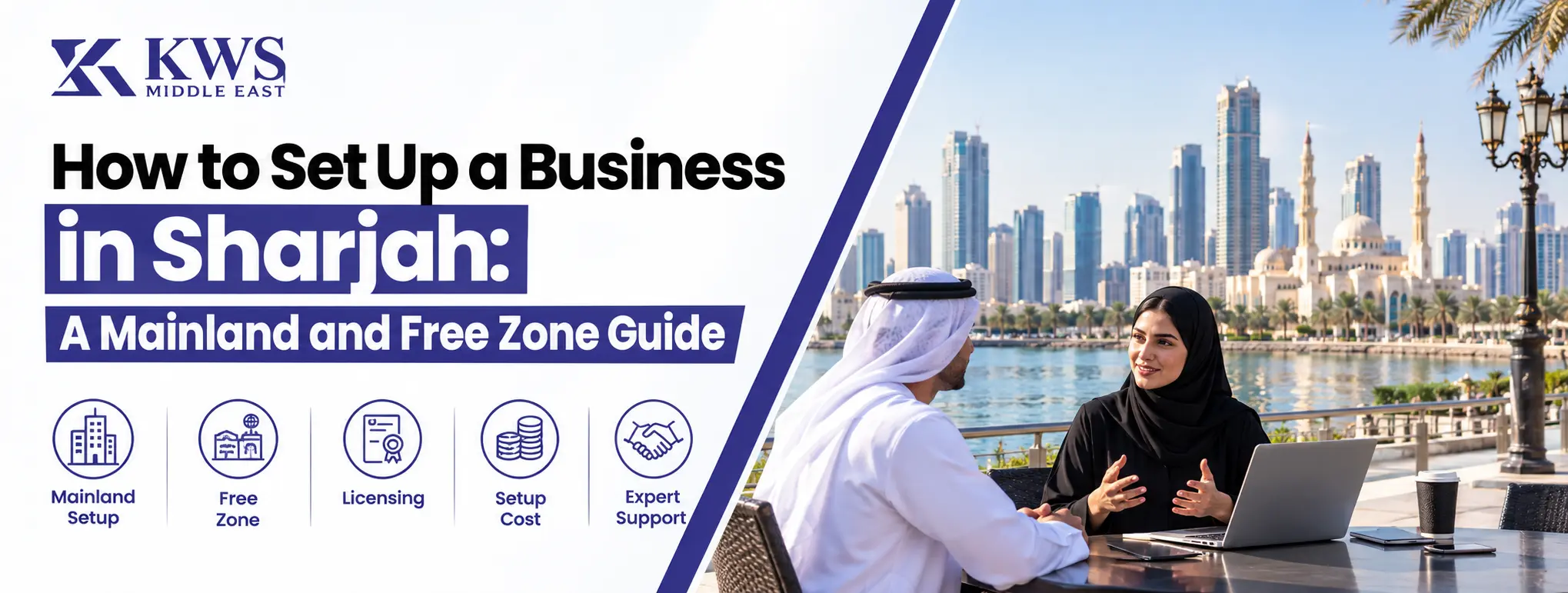
If you’re comparing Sharjah to Dubai for your next company, the short answer is that Sharjah can work out cheaper to set up and run, but the right choice depends on whether your business needs to trade physically across the UAE, and whether a mainland licence or one of Sharjah’s six free zones fits your activity better. This guide walks through both routes so you can make that call with real information rather than a single headline number.
Sharjah sits about 20 to 30 minutes from Dubai by road, hosts three seaports and an international airport, and carries roughly a third of UAE manufacturing activity. That combination makes it a genuine option for trading, industrial, logistics, and media businesses — not just a cheaper alternative to Dubai for its own sake.
Why Entrepreneurs Choose Sharjah Over Dubai
Three factors come up most often when businesses choose Sharjah:
Lower setup and operating costs. Office rents, licence fees, and many free-zone packages in Sharjah are generally lower than Dubai equivalents for comparable space and activity, though the exact gap depends on the zone, activity, and office type you choose.
Industrial and logistics capacity. Hamriyah Free Zone and SAIF Zone were built around heavy industry, manufacturing, and port access, which makes Sharjah a stronger fit than Dubai for certain trading and industrial activities.
Proximity to Dubai without Dubai costs. Many founders base a company in Sharjah while still serving Dubai clients, using the short commute to keep overheads down. This only works cleanly if you understand the market-access rules covered below — a Sharjah free-zone company cannot automatically operate inside Dubai the way a Dubai mainland company can.
Mainland or Free Zone in Sharjah — Which Should You Choose?
This is the decision almost every reader of this page is actually trying to make, and it depends on where and how you plan to trade.
| Factor | Sharjah Mainland | Sharjah Free Zone |
|---|---|---|
| Where you can trade | Anywhere in the UAE, including directly with Dubai and other emirates | Primarily within the free zone and internationally; UAE mainland trade generally requires a local distributor or a separate mainland presence |
| Foreign ownership | Up to 100% for most commercial and industrial activities since the 2021 Commercial Companies Law reform; some activities and professional licences may still require a UAE national service agent or partner | Up to 100% foreign ownership as standard |
| Office requirement | Physical premises with a registered Ejari tenancy contract, in most cases | Ranges from flexi-desks to warehouses and industrial plots, depending on the zone |
| Typical best fit | Businesses that need to sell or deliver services across the UAE, government-facing activities, retail with a Sharjah or wider-UAE customer base | Import/export, manufacturing, media, publishing, healthcare-related, or research activities that don’t need a mainland UAE customer-facing presence |
| Authority | Sharjah Economic Development Department (SEDD) | The relevant free-zone authority (see below) |
If your business will invoice and deliver to clients across Dubai and the wider UAE, mainland is usually the more practical route. If your business is trading internationally, manufacturing, or operating within a specific industry a Sharjah free zone was built for, a free zone can be both cheaper and better suited to the activity.
What Business Structures Are Available on the Sharjah Mainland?
SEDD licenses several structures, and the right one depends on how many owners are involved and how liability should be shared.
Limited Liability Company (LLC). The most common structure for trading, industrial, and many service businesses. It allows between two and fifty partners, and each partner’s liability is limited to their share of the capital.
Civil company / professional firm. Used for professional activities — consultancy, legal, accounting, medical and similar services — typically owned by the professionals themselves rather than investors.
Sole establishment. A single-owner structure, generally used by individuals running a professional or small commercial activity, where the owner carries personal liability.
Branch of a foreign or UAE company. Lets an existing company operate in Sharjah under its parent company’s name and activity, without forming a new legal entity.
Public or private shareholding company. Used for larger businesses that plan to raise capital through tradable shares — a less common starting point for new SMEs.
Which of these fits depends on your business activity and how many people are involved, so confirm the licence category with SEDD or a setup consultant before reserving a trade name.
What Are Sharjah’s Free Zones, and Which One Fits Your Business?
Sharjah has six free zones, each built around specific industries rather than being interchangeable. Choosing the wrong one for your activity is one of the most common — and most expensive — mistakes founders make.
| Free Zone | Authority | Best suited to |
|---|---|---|
| Hamriyah Free Zone (HFZA) | Hamriyah Free Zone Authority | Heavy industry, manufacturing, oil and gas, petrochemicals, steel, logistics — one of the UAE’s largest industrial free zones |
| SAIF Zone (Sharjah Airport International Free Zone) | SAIF Zone | Trading, aviation-linked business, logistics companies that benefit from on-site customs and airport access |
| Shams (Sharjah Media City) | Shams | Media, content, consultancy, and wholesale/retail businesses wanting a lower-cost alternative to Dubai’s media free zones |
| Sharjah Publishing City (SPC) | SPC | Publishing, printing, and related wholesale/retail and consultancy activities |
| Sharjah Research, Technology & Innovation Park (SRTIP) | SRTIP | R&D-driven businesses in water management, renewable energy, smart manufacturing, and environmental technology, often working with government or academic partners |
| Sharjah Healthcare City (SHCC) | Sharjah Healthcare City | Hospitals, clinics, laboratories, and healthcare-related R&D |
KWSME already covers Hamriyah Free Zone in detail, including its licence types and setup process, in our Hamriyah Free Zone business setup guide. If your activity is industrial, trading, or logistics-focused, that’s the right next page to read.
What Licence Do You Need for Your Business Activity?
Both SEDD and the Sharjah free-zone authorities issue licences in the same broad categories used across the UAE:
- Commercial licence — trading, retail, and general commercial activities
- Professional licence — services, consultancy, and skill-based activities
- Industrial licence — manufacturing, processing, and production activities
The licence category follows the activity, not the other way around, so define your exact business activity before choosing a structure or a zone.
How Do You Register a Business in Sharjah? (Mainland Process)
The general sequence for a Sharjah mainland licence looks like this. Some steps vary depending on your activity and whether external approvals apply.
- Determine your business activity. This decides your licence category and whether any external government approval is needed before you can proceed.
- Check trade name availability with SEDD and reserve your preferred name.
- Confirm your ownership structure, including whether your activity requires a local service agent or UAE national participation.
- Obtain initial approval from SEDD to proceed with the application.
- Draft and notarise your Memorandum of Association (MOA) for LLCs and partnerships.
- Secure premises and register your Ejari tenancy contract, where a physical office is required for your activity.
- Obtain any activity-specific external approvals — for example, from a relevant regulator if your activity is regulated.
- Submit your trade licence application to SEDD along with your documents and pay the applicable fees.
- Apply for an establishment card through the UAE immigration authority if you plan to sponsor employee or investor visas.
Free-zone registration follows a parallel but shorter process run entirely through the relevant free-zone authority rather than SEDD.
What Documents Are Required for Sharjah Company Registration?
Requirements vary by structure and activity, but most applications require:
- Passport copies of all shareholders and managers
- Proof of UAE residence or entry visa, where applicable
- Memorandum and Articles of Association (for LLCs and partnerships)
- A notarised Power of Attorney if a representative is filing on your behalf
- A signed lease agreement or Ejari certificate
- No-Objection Certificate (NOC) for any UAE national shareholders or service agents
- Any activity-specific approval letters from the relevant regulator
Confirm the exact document list for your activity and structure with SEDD or your chosen free-zone authority, since requirements can change.
How Much Does It Cost to Set Up a Business in Sharjah?
There’s no single accurate number here, and any page that gives you one flat figure without a breakdown is asking you to trust an unsourced estimate. Total cost depends on your licence type, chosen zone, office format, and visa quota, and it’s built from several separate components:
- Trade name reservation and initial approval fees — government charges paid to SEDD or the free-zone authority
- Licence fee — varies by activity and licence category
- Registration and MOA notarisation — for LLCs and partnerships
- Office or facility cost — a flexi-desk in a free zone is typically the lowest-cost option; a physical mainland office with Ejari registration costs more
- Local service agent fee, where one applies to your activity — this is a fixed annual fee, not a share of profit
- Establishment card and visa costs, if you plan to sponsor visas
- External approval fees, if your activity requires regulator sign-off
- Professional service fees, if you use a setup consultant
As a general pattern, Sharjah free-zone packages tend to start lower than Sharjah mainland licensing, and both typically come in below equivalent Dubai packages — but treat any specific AED figure you see online, including on this page’s earlier competitor research, as indicative rather than official until you’ve confirmed it directly with SEDD or the relevant free-zone authority, since fees are revised periodically.
How Long Does the Sharjah Business Setup Process Take?
Free-zone registration is usually the faster route, often completed within one to two weeks once documents are in order. Mainland registration typically takes longer — commonly a few weeks to around two months — mainly because of external approvals for regulated activities and the time needed to secure and register a physical office. Activities requiring additional regulatory sign-off (healthcare, education, financial services, and similar) will generally take longer than a standard trading or consultancy licence.
Do You Need a Local Service Agent in Sharjah?
This is one of the most commonly misunderstood parts of UAE company formation, and it’s worth being precise about it.
Since the 2021 amendments to the UAE Commercial Companies Law, most commercial and industrial activities on the UAE mainland — including Sharjah — allow up to 100% foreign ownership without a UAE national partner. A local service agent, where still required, is typically an administrative role for certain professional licences or specific regulated activities, paid a fixed annual fee rather than holding equity or a share of profit.
Because the exact rule depends on your specific business activity, confirm your ownership position with SEDD, or with a setup consultant who can check the current activity list, before you commit to a structure.
Do You Need an Office in Sharjah?
It depends on your jurisdiction and activity. Most Sharjah mainland licences require a physical office with a registered Ejari tenancy contract. Sharjah’s free zones are generally more flexible: many activities can be licensed against a flexi-desk or shared workspace, while industrial and warehousing activities in zones like Hamriyah and SAIF Zone require dedicated facilities suited to the operation. Confirm the office requirement tied to your specific activity and licence type before budgeting for premises.
What About Visas When You Set Up a Business in Sharjah?
A Sharjah company — mainland or free zone — can generally sponsor residence visas for investors, partners, and employees, subject to your visa quota. That quota is usually linked to your office size or licence package, so it’s worth confirming upfront if you know you’ll need to sponsor several employees early on. The process runs through an establishment card issued by UAE immigration once your trade licence is active, followed by individual visa applications, medical testing, and Emirates ID registration for each sponsored person.
What Taxes Apply to a Sharjah Company?
UAE federal corporate tax applies at 9% on taxable profit above AED 375,000, with profit below that threshold taxed at 0%, regardless of emirate. Free-zone companies that meet the conditions for “qualifying income” may continue to benefit from a 0% rate on that income, though this depends on the specific activity and compliance with the qualifying-income rules — it isn’t automatic just because a company is registered in a free zone. Smaller businesses may also be eligible for Small Business Relief, subject to revenue thresholds and conditions set by the Federal Tax Authority. VAT at 5% applies to most goods and services where the standard VAT registration thresholds are met.
For a full breakdown of thresholds, exemptions, and filing obligations, see our dedicated UAE Corporate Tax guide. Because tax rules and thresholds are updated periodically, confirm your specific position with the Federal Tax Authority or a tax advisor rather than relying on this summary alone.
Sharjah vs Dubai: What Should You Actually Compare?
Proximity to Dubai is the fact every Sharjah setup guide mentions. It’s rarely the fact that should drive your decision. What actually matters:
Where your customers are. A Sharjah mainland company can trade anywhere in the UAE, including Dubai, without restriction. A Sharjah free-zone company generally cannot operate a customer-facing presence inside Dubai without a separate mainland licence or a local distributor — so if most of your revenue will come from Dubai clients who expect to visit your premises, a Sharjah free zone alone may not be the right fit.
What you’re building. Sharjah’s industrial free zones give it a genuine edge over Dubai for manufacturing, heavy trading, and logistics operations that need port access and industrial land at a lower cost base.
Cost versus market perception. Sharjah setup and running costs are generally lower, but some business categories — particularly premium services and international headquarters functions — still lean toward a Dubai address for client perception. Weigh the cost saving against whether your specific customers or investors care where you’re registered.
Commute reality, not just distance. The 20 to 30-minute drive between Sharjah and Dubai is manageable for most business functions, but factor in Sharjah’s own traffic patterns during peak hours before assuming the commute is negligible for staff or clients.
Common Mistakes When Setting Up a Business in Sharjah
Picking a free zone based on cost alone. The cheapest package is a poor choice if it’s the wrong zone for your activity — a trading business in Shams (a media zone) will struggle to get the right activity licence, for example.
Assuming a free-zone licence covers UAE-wide trading. It doesn’t, by default. If mainland UAE trade is core to your business, plan for a mainland licence or a distribution arrangement from the start.
Underestimating approval timelines for regulated activities. Healthcare, education, and financial activities carry external approval steps that can extend your timeline well beyond a standard commercial licence.
Treating the local service agent fee as a partnership. Where a service agent is required, it’s typically a fixed annual fee for an administrative role, not a share in your company or its profits — don’t structure your budget or expectations around it being anything more.
Ignoring renewal costs. Licence renewal, Ejari renewal, and visa renewal are recurring costs that some first-time founders don’t budget for after the initial setup.
How Can KWS Middle East Help You Set Up a Business in Sharjah?
KWS Middle East can help you work through the mainland-versus-free-zone decision for your specific activity, identify which of Sharjah’s six free zones actually fits your business, and manage the licensing, documentation, and visa process from trade name reservation through to your establishment card. If you’re weighing Sharjah against Dubai or another emirate, we can walk through the real trade-offs for your business rather than a generic comparison.
If you’re ready to move from research to setup, KWS Middle East can assess your business activity and recommend the Sharjah structure — mainland or free zone — that actually fits, before you commit to a licence.